
Maslow's pyramid: Is the hierarchy of needs theory still relevant?

Updated: Aug 3

Maslow's Pyramid, also known as Maslow's Hierarchy of Needs, is one of the most influential theories in psychology describing how our desires influence our behavior. Abraham Maslow was a psychologist who lived from 1908 to 1970. He proposed this concept in the mid-20th century, suggesting that our actions are driven by attempts to satisfy specific needs, progressing from the most basic to self-actualization.
In this article, we'll discuss in detail what Maslow included in his theory of needs and why understanding this hierarchy is crucial for personal development, management, and a general understanding of human behavior. Knowing Maslow's classification of needs allows for a better understanding of the motivations behind people's actions, which is incredibly valuable in both personal and professional life.
And what is extremely interesting, in the last part of this article, we will show that there were 6 levels in total, not 5!
What is Maslow's Pyramid? Types of needs.
Maslow's Pyramid is a psychological model that divides human needs into five levels, starting with physiological needs, then progressing through safety, belonging, esteem, and finally self-actualization. This theory is based on the fundamental premise that only after lower-level needs are met can a person pursue higher-level needs.
It was first published in 1943 as an article in the respected scientific journal Psychological Review.
Maslow developed a special research program and tested relatively large groups of healthy individuals, including, for example, 1% of the American university student population.
Interestingly, among the individuals he personally analyzed were well-known names such as Albert Einstein, Eleanor Roosevelt, Jane Addams, and Frederick Douglass. He also decided not to study people with mental illness or neurosis, justifying his decision as follows:
“The study of crippled, underdeveloped, immature, and unhealthy patients can only produce a psychology and philosophy of cripples.”
The entire theory was described in more detail in 1954 in the book "Motivation and Personality".
Importantly, Maslow believed that " the levels of the hierarchy are interconnected, not completely separate." This means, among other things, that to reach a given floor of the pyramid, a person must not only pass through the previous levels but also fully master them.
The hierarchy of needs is often presented in the shape of a pyramid. However, it's worth noting that Maslow himself never used a pyramid to describe the levels in any of his writings. So how did we end up with the right-angled triangle we use today?
Maslow's theory of needs was first adopted by Douglas McGregor, who saw an opportunity to apply it to management. However, he did not create any graphical representation.
Keith Davis did this in his 1957 book on management. Interestingly, this visualization didn't catch on until 1960, when business psychologist Charles McDermid published an essay featuring a pyramid.
The image below shows this original artwork.

Since then, the presentation of classification in triangle form has become ingrained in the collective consciousness and gained popularity worldwide.
The graphic in the header of this article shows this model.
Physiological needs: The foundation of the pyramid.
At the lowest level of the human needs pyramid are physiological needs, which are essential for human survival, such as air, water, food, shelter, and sleep. According to the hierarchy of needs, satisfying physiological needs is a necessary condition for seeking satisfaction at higher levels.
Important note: basic physiological needs also include the need for sex, which we will address later in the article.
The need for security: The search for stability.
The next level involves meeting the need for security, which encompasses both physical and economic security. The most fundamental aspect is the ability to live in peace. Unfortunately, the increasing number of armed conflicts, international tensions, Russia's aggression in Ukraine, another war between Israel and Hamas, the growing waves of refugees, and the escalating terrorist attacks only serve to increase concern.
It also encompasses personal safety, meaning protection against violence, aggression, unequal treatment, or discrimination. It also encompasses the need for safety on public transport and the freedom to leave home after dark. It's sad to say that in the 21st century, going on a trip, attending a concert, or attending a mass sporting event is increasingly risky.
Another important component is health security, both physical and mental. This includes healthy eating, mental balance, and appropriate medical care. Unfortunately, for some time now, this has also been linked to the safety of our planet, the greenhouse effect, global climate change, dramatically increasing air pollution, and the impact of plastic on all living organisms.
The next aspect is psychological safety at work. Without it, no benefits or financial incentives will work and will not influence employee engagement. Satisfying this need involves the ability to be oneself, openly express one's opinions, maintain stress levels, and maintain a healthy work-life balance. Unfortunately, in extreme cases, this is disrupted by mobbing or sociopathic behavior from superiors.
Another example of achieving this level in today's world is a stable job, accumulating savings, or securing your own apartment.
The need to belong: Connecting with others.
On the third level of Maslow's pyramid is the need for belonging. It refers to a person's desire to be part of a group, maintain interpersonal relationships and friendships, and experience love. People need to feel part of a group (whether family or peer group). They also need contact with others and acceptance by their group.
This is a key element that motivates people to build strong emotional bonds with others. This element is particularly evident during the teenage years. This is when children begin to separate from their parents, and belonging to a group becomes most important. In a more mature context, people desire love and want to be loved. Closeness, connection, and intimacy are reflections of this. When the need for love and belonging is not met, many people become susceptible to loneliness, social anxiety, and depression.
Need for recognition: Seeking respect.
This level concerns the desire to be appreciated and respected by those around us. It is also related to the need for respect and self-esteem.
This applies to both personal and professional life. Moreover, perhaps the personal sphere is far more important. Why? Because a healthy sense of self-worth is the foundation of mature interpersonal relationships — in every area of life. Therefore, feeling appreciated and noticed is just as important in a romantic relationship as it is at work. We'll devote a separate section to the professional sphere in a moment.
The need for self-actualization: The top of Maslow's hierarchy.
Self-actualization, the highest level of self-actualization, refers to achieving one's full potential, realizing one's dreams and ambitions, and developing individual talents. It is a process of constantly striving to be the best version of oneself. This may vary from person to person.
Each of us is a unique individual, and as Einstein said, " Everyone is a genius, just each in a different field ." The key is to get to know yourself well, chart your individual path, and strive to maximize your potential. The most difficult part is gaining a deep understanding of yourself and accepting your uniqueness, including its darker sides.
The hierarchy of human needs and management. What is its importance at work?
Understanding Maslow's hierarchy of needs can significantly impact the effectiveness of workplace management by properly addressing employee expectations. Successfully meeting these needs at various levels has a profound impact on people's motivation. This is a crucial element of our existence, especially in the 21st century, dominated by competition, career orientation, goals, and achievement. In the workplace, this is another complex topic.
A good understanding of employee expectations is crucial to building engagement. Appreciation and recognition can take many forms: from a simple and sincere "thank you, well done!" to rewards, bonuses, promotions, and personalized development paths. But let's also remember the order of the relevant elements.
Safe working conditions are an absolute must. First, it's essential to create a work environment that guarantees employee psychological safety. Without this, any form of higher-level recognition will fail.
Let's remember that the lack of basic needs means that everyone will struggle to meet them first. Only after eliminating the deficit can we set ourselves larger and more ambitious goals.
Maslow's pyramid of needs and personal development.
Maslow's theory explains human functioning and explains that, at the most fundamental level, we are not different from each other. It also emphasizes that harmonious personal development can be achieved by following a valid sequence of needs and motivations. Full self-fulfillment is possible only after satisfying lower-level needs.
Perhaps it carries an important message for all spiritually minded individuals seeking spiritual enlightenment. It seems that without the harmonious arrangement of all the previous levels, such enlightenment is impossible. It also suggests not devaluing material things and not neglecting our bodies. We are a whole, and the vital needs of every person are equally important at every level. There are no inferior or superior levels. Only by fulfilling all of them does one have the chance to complete the harmonious, multidimensional whole that is humanity.
What can Maslow's hierarchy of needs be used for in everyday life?
In everyday life, understanding Abraham Maslow's hierarchy of needs helps us better understand other people's behavior. This is perhaps best summed up by the popular saying, "The well-fed cannot understand the hungry." Age also plays a role. If, for example, you're irritated by the pace of older people's movements or their cautiousness and reluctance to take risks, believe me, you'll fully understand this in a dozen or so years. The same applies to a sense of economic security.
Critique and relevance of Maslow's theory. Was the American psychologist wrong?
Despite its popularity, the concept is not free from criticism. Primarily, it concerns reservations about the universality of the hierarchy of needs.
The world has moved on considerably since its first publication in 1943. Furthermore, it's significant that its publication coincided with World War II and the many tragic events that challenged human survival.
One of the main criticisms is the lack of distinction between individualistic societies, such as Western countries, and collectivist societies, such as nations and tribes of Africa.
Individualistic societies are more self-centered and focus on the constant pursuit of self-improvement. Consequently, self-fulfillment truly comes first. In societies where community is the primary good, belonging and acceptance within the group overrule individual self-fulfillment.
Another area of criticism concerns the position and value of sexual needs. Maslow placed them among the physiological needs, along with eating and breathing. This means, among other things, that without satisfying sexual needs, one cannot progress to higher levels. It also trivializes this sphere of human life, stripping it of crucial emotional elements, including the sense of connection and closeness.
Moreover, in the 1980s and 1990s, numerous studies on the influence of circumstances on changes in the human need system were conducted. This once again tested the universality of these principles. This applied not only to the various circumstances an adult might encounter, but also to various stages of human development.
First, differences were demonstrated depending on whether people lived in times of war or peace. Second, it turned out that within these periods, differences in the classification of human needs may still exist, depending on national culture and geography.
In 1981, differences were examined between different age groups. Researchers found that, compared to all other age groups, children placed the highest value on physical well-being. The desire for love was present in everyone from childhood to adulthood. Among young people, one need was paramount: esteem. Adults valued self-fulfillment the most. Older people, on the other hand, placed safety first.
Therefore, the authors of the study concluded that the pyramid created by Maslow cannot be considered a concept of the human development path, because, for example, the order of love and self-esteem should be reversed depending on age.
📌 Summary: What should you remember about meeting human needs?
American psychologist Abraham Maslow's pyramid presents the theory of the hierarchy of human needs.
Satisfying lower-order needs (i.e., physiological and safety) is essential for human biological survival. At the same time, it is a necessary condition for the satisfaction of higher needs. One cannot progress to higher levels unless the lower needs are met.
Maslow's theory has broad applications in everyone's life, from individual development, relationships with others, to team management.
Despite criticism, it still offers valuable insight into human functioning and development and explains motivational mechanisms.
Understanding Abraham Maslow's pyramid allows for a deeper understanding of human behavior, which is crucial both personally and professionally. It's an important step toward better understanding ourselves and others.
A major controversy - how many levels were there really?
Based on research by Mark E. Koltko-Rivera and others, Maslow added a sixth level called self-transcendence.
The image below contains the original description of this level.

The author himself discusses it in a speech given in 1967, three years before his death. It's a valuable recording in which he explains his path. Here's an excerpt from his speech:
There are people who feel loved and capable of love, who truly feel safe, respected, and have self-respect. If you study these people and ask what motivates them, you will find yourself in a different dimension. I must call this realm transhumanist, meaning one that motivates, satisfies, and activates a happy, developed, and self-actualized person. These people are motivated by something beyond basic needs... The entry point into this transhumanist realm occurs when they answer the following questions: "What are the moments that give you... the greatest satisfaction? What are the moments of reward that make your work and life worthwhile?" The answers to these questions concerned ultimate truths... For example: truth, goodness, beauty, and so on.
The full version of his statement can be viewed in the video available at the link below:
In his journal in 1961, Maslow also wrote these words:
(...) This means that the greatest achievement of identity, autonomy, or being is itself simultaneously a transcendence of self, a going beyond and beyond oneself. A person can then become relatively egoless.
Therefore, according to Maslow, there is something beyond us. Even if all the above-mentioned human needs are satisfied, a longing for something transcendent will arise, and the process of satisfying needs ends outside of the person.
So, I can't help but reflect on this: another psychology expert, at the end of his life, addresses something much larger than the individual. The collective unconscious and Carl Gustav Jung, whom we discuss in a separate post, are another example!
See also other related articles:
Check biographies and achievements of other key figures who contributed to the development of psychology:
Fritz Perls - suffering, rebellion, war, Zen, theater, and finally psychotherapy.
Hawkins Levels of Consciousness and Kinesiology Test.
Viktor Frankl and his logotherapy.
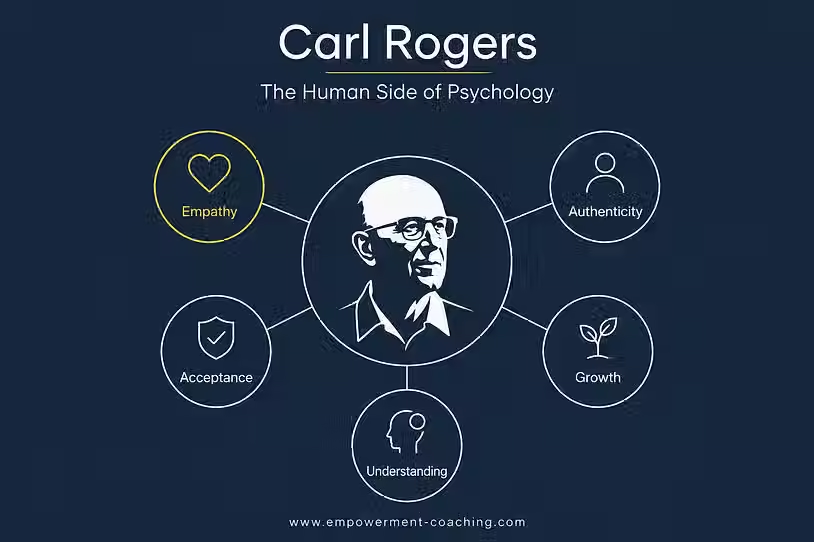
Carl Rogers and humanistic psychology.
Erik Erikson and the theory of psychosocial development.
How to choose a personality test?
50 Minds That Changed the World - The Complete Guide.


Comments