
Carl Rogers – The Humanistic Psychology That Changed Psychotherapy

Updated: Aug 19
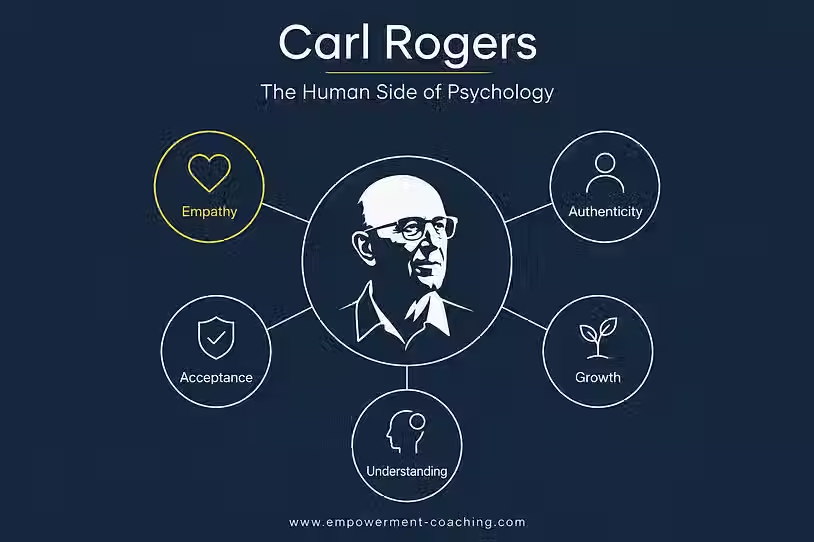
Carl Rogers is one of the most important figures in 20th-century psychology and a true icon of psychotherapy. As an American psychologist and psychotherapist, he created an approach that forever changed our understanding of humanity, the therapeutic relationship, and personal development. His concepts have had a profound influence on psychotherapy, education, coaching, and modern leadership. He was one of the most important representatives of the humanistic movement and co-founder of the approach now known as humanistic psychology.
At the heart of his philosophy were the client and the belief that every person possesses natural potential for development and the ability to shape their own life. Instead of focusing on diagnosis and control, he proposed an authentic encounter based on empathy, respect, and a deep understanding of the other person. As a result, his client-centered therapy remains one of the foundations of humanistic psychotherapy to this day.
Carl Rogers: A Short Biography.
Carl Ransom Rogers was born on January 8, 1902, in Oak Park, Illinois, USA, into a religious and conservative Protestant family. He was the fourth of six children of Walter Rogers, an engineer and entrepreneur, and Julia Cushing, a deeply religious woman. He was raised in an atmosphere of discipline, hard work, and strong Christian values. When Carl was a child, the family moved to a farm outside Chicago, where he developed an interest in nature, observing people, and thinking for himself.
He initially studied agriculture at the University of Wisconsin. After graduating in 1924, he married Helen Elliot, an artist who played an important role in Carl's personal life. According to biographers, the marriage was entered into despite his parents' expectations and reservations.
That same year, he began his studies at Union Theological Seminary in New York. After two years, he abandoned the priesthood and turned his attention to the study of humanity.
In 1926, he entered Teachers College at Columbia University, where he earned an MA (Master of Arts) in 1927 and a PhD in clinical psychology in 1931. He then began an intensive clinical practice with children and families.
His only daughter, Natalie Rogers, was born on October 9, 1928. She later became a renowned psychologist and founder of Person-Centered Expressive Arts Therapy, developing her father's ideas towards expressive therapy and creativity.
From 1935 to 1940, he taught at the University of Rochester, while also running a support center for children and families (Rochester Society for the Prevention of Cruelty to Children). It was then that he wrote his first book, The Clinical Treatment of the Problem Child (1939).
In 1940, Rogers became a professor at Ohio State University. Shortly thereafter, he published his second book, Counseling and Psychotherapy (1942).
In the 1940s and 1950s, he developed his own approach known as client-centered therapy. It became one of the foundations of humanistic psychotherapy.
From 1945 to 1957, he worked as a professor at the University of Chicago, simultaneously establishing a psychological support center. Through a combination of theoretical and practical work, he studied the effectiveness of his methods. He presented his findings in a groundbreaking book, "Client-Centered Therapy," published in 1951.
From 1957 to 1963, he taught at the University of Wisconsin. It was then that he wrote his second famous work, "On Becoming a Person" (1961). It was also then that he and Abraham Maslow launched the humanistic psychology movement.
In 1963, he moved to La Jolla, California, where he was appointed Professor-in-Residence at the Western Behavioral Sciences Institute (WBSI). At the same time, he co-founded the Center for Studies of the Person and engaged in projects related to communication, education, and social conflict resolution. He remained there for the rest of his life, continuing his therapeutic practice, lecturing, and writing books.
Carl Rogers died on February 4, 1987, in La Jolla, California, at the age of 85, a few days after breaking his hip in a fall. He remained professionally active until the end of his life.

What was Rogers' theory like? What was unique about his approach?
Rogers's most important theory was based on the belief that every person possesses the natural potential for development and self-fulfillment. Unlike many earlier perspectives, he believed that people are not inherently "broken" but possess the capacity to grow and mature.
The humanistic dimension of his approach relied on the recognition of human subjectivity. He focused on the client's real experiences, emotions, and perceptions of the world. The phenomenological field, or individual way of experiencing reality, was of key importance.
According to Rogers, people develop best when they can experience authentic relationships and feel emotionally safe. This idea has become the foundation of many contemporary therapeutic methods.
In his 1951 book, he formulated the so-called 19 propositions that form a coherent theory of personality.
We present them in the graphics below.


What is client-centered therapy?
Rogers's most famous achievement was client-centered therapy, also known as client-centered psychotherapy. In this model, the person is not a passive recipient of the therapist's interpretations, but an active participant in the change process.
Rogers deliberately used the word "client" instead of "patient." He wanted to emphasize the individual's agency and responsibility for their own life. The therapist was not meant to dominate or impose solutions. Their role was to listen, support, and create a safe space for growth.
This approach was revolutionary because it reversed the traditional model of the therapeutic relationship. The psychologist believed that the client best understood their own needs and development direction.

What was most important in the therapeutic relationship?
Rogers believed that effective therapy depends primarily on the quality of relationships. He described three fundamental conditions that help a person develop:
congruence,
empathy,
unconditional acceptance.
Congruence signified the therapist's authenticity, which should not hide behind a professional mask. He or she should be genuine and emotionally coherent. This allows the client to experience real interpersonal contact.
The second important element was the ability to listen to another person with complete engagement. The author believed that most people never experience true listening. Yet, it can have a profoundly positive impact.

Why was acceptance so important in humanistic psychotherapy?
Unconditional acceptance meant the therapist's ability to accept a person as he or she is — without judgment or moralizing.
Rogers emphasized that people need an environment in which they can accept their own emotions and experience psychological safety. Only then is authentic growth possible. In practice, the therapist was expected to be a supportive, empathetic, and trustworthy person in contact with others.
It is thanks to this philosophy that psychotherapy began to focus on the relationship with the client rather than on the techniques themselves.
Why was humanistic psychology groundbreaking?
Humanistic psychology emerged as an alternative to psychoanalysis and behaviorism. This approach focused on human development, freedom of choice, and self-fulfillment.
Rogers was one of the most important researchers of interpersonal relationships. His approach assumed that humans possess the capacity for growth when placed in the right emotional environment. This hypothesis had a profound influence on subsequent developments in therapy, education, and coaching.
As the creator of the humanistic approach, he inspired not only psychologists but also leaders, teachers, and people working on organizational development.
For example, one of his students was Marshall Goldsmith, author of the famous concept of Nonviolent Communication (NVC). Another alumnus, Thomas Gordon, founded the Parent Effectiveness Training movement.
In his later years, Rogers focused on addressing issues of political oppression and social conflict around the world, facilitating dialogue between Protestants and Catholics in Belfast, Black and white people in South Africa, and those transitioning to democracy in Brazil.
From 1974 to 1984, he, his daughter Natalie, Maria Bowen, Maureen O'Hara, and John K. Wood traveled throughout the United States, Europe, Brazil, and Japan, leading Person-Centered Approach Workshops focusing on cross-cultural communication, personal development, self-fulfillment, and learning for social change.
At the age of 85, he made his last trip to the Soviet Union, where he led workshops promoting communication and creativity.

How did Carl Rogers understand man and personal development?
Rogers argued that humans have a natural tendency to grow and develop. However, the key was to create the appropriate emotional conditions in which the individual could feel safe.
Authenticity and the ability to build genuine connections with others played a crucial role in his approach. He emphasized that people need relationships based on respect and understanding.
At the heart of his approach was the development of self-concept and the transition from an undifferentiated to a fully differentiated self.
Here is his definition of self-concept:
An organized, coherent, conceptual gestalt composed of perceptions of the qualities of "I" or "me" and perceptions of the relationships of "I" or "me" to others and various aspects of life, along with the values assigned to these perceptions. This is a gestalt that is accessible to consciousness, though not necessarily in conscious awareness. It is a fluid and changing gestalt, a process, but at a given moment it is a specific entity.
According to Rogers, individuals raised in an environment of unconditional positive attention have the potential for full self-fulfillment. Individuals raised in an environment of conditional positive regard feel valuable only when they meet the conditions set for them by others.
His concepts still inspire people working in personal development, coaching, and modern leadership.
Why did Rogers also influence coaching and education?
Although Rogers is primarily associated with therapy, his concepts have also had a profound impact on coaching, mentoring, and education. Many contemporary trainers and coaches use his method of conducting conversations and building relationships.
He believed that effective human development requires partnership, not expert domination. Therefore, the modern psychotherapist, coach, and leader increasingly uses methods based on empathy and authenticity.
His concepts were applied in the field of interpersonal communication. In 1964, he began collaborating with the research community, and in 1968, he founded the Center for Research on the Person.
“Humanistic psychology has influenced not only therapy but also coaching, education, and modern leadership.”

What significance does Rogers have for contemporary psychotherapy?
Today, Rogers's influence is evident in virtually every modern therapeutic practice. Even therapists from other schools often draw on his approach to relationships and communication.
He demonstrated that effective psychotherapy need not rely solely on interpretation and diagnosis. Relationship, empathy, and the ability to truly connect can, in and of themselves, have enormous transformative power.
To this day, he is considered one of the most important figures in contemporary psychology and psychotherapy.
"Rogers changed psychotherapy by shifting the focus from diagnosis to the relationship with the person."
📌 The most important information – summary.
Carl Rogers was one of the most important psychologists of the 20th century.
He was a co-founder of humanistic psychotherapy.
He created client-centered therapy.
He emphasized the importance of empathy, authenticity, and relationships.
He believed that man has a natural potential for development.
Instead of the word "patient", he used the term "client".
His ideas have influenced coaching, education, and organizational development.
To this day, it remains a symbol of the human view of man.
FAQs.
Who was Carl Rogers?
Carl Rogers was an American psychologist and psychotherapist, co-founder of humanistic psychology, and the founder of client-centered psychotherapy. He believed that humans possess an innate capacity for growth and that the therapist's role is to foster a secure relationship grounded in empathy, congruence, and unconditional acceptance.
What was Rogers' theory?
Rogers believed that people thrive in an atmosphere of understanding and authentic connection. In his approach, clients are not passive patients, but active individuals capable of taking responsibility for their own lives.
Sources:
Here are the sources used for this writing:
Farber, Barry A. The psychotherapy of Carl Rogers: cases and commentary (Guilford Press, 1998).
Thorne, Brian. CR Rogers—Key Figures in Counseling and Psychotherapy series (Sage Publications, 1992).
Cornelius-White, Jeffrey (March 2007). “Learner-Centered Teacher-Student Relationships Are Effective: A Meta-Analysis.” Review of Educational Research. 77 (1): 113–143
See related articles:
Check biographies and achievements of other key figures who contributed to the development of psychology:
Fritz Perls and Gestalt Therapy.
Hawkins Levels of Consciousness and Kinesiology Test.
Theory of Psychosocial Development: Erikson's Crises and Stages of Development.
Viktor Frankl and his logotherapy.
What is Maslow's pyramid?
How to choose a personality test?
50 Minds That Changed the World - The Complete Guide.


Comments