
What is cognitive dissonance: definition and influence on our decisions

Updated: Aug 7

Cognitive dissonance is a key concept in modern psychology that helps us understand why people can think one thing, say another, and do a third. If you've ever justified a decision that clearly conflicted with your values, felt internal discomfort after making a choice, or rationalized behavior that didn't align with you, you've likely experienced this state.
In this article, we will explain what dissonance is, show examples and mechanisms of unconscious reduction, and demonstrate how this psychological phenomenon is sometimes used in manipulation and social communication.
We will also describe how coaching helps identify and remove internal dissonance.
What is cognitive dissonance? Definition.
Simply put, it's a state of unpleasant mental tension that occurs when there's a discrepancy between cognitive elements in a person's psyche. These elements may be beliefs, attitudes, opinions, knowledge, or behaviors.
This is a situation in which our thinking is internally inconsistent. When one element contradicts another, tension arises, which psychology describes as dissonance.
Cognitive dissonance can be called a kind of guilty conscience that robs us of inner peace. It's a state in which the mind strives to restore consistency, even at the cost of distorting the facts.
How did this concept appear in psychology?
This term has its roots in social psychology, which studies how individuals function in relationships with others and how social factors influence human thinking and behavior.
Researchers long ago recognized that people don't always behave rationally and couldn't explain it. The theory of cognitive dissonance explains why people can defend decisions that are objectively wrong or persist in certain assumptions despite evidence to the contrary. This theory also helps explain why contradictions between knowledge and experience are often ignored.
Leon Festinger's theory of cognitive dissonance.
The author of the classic theory is Leon Festinger, who in the 1950s described the mechanisms of dissonance formation and reduction.
Festinger's theory assumes that:
dissonance occurs when there is an inconsistency between two cognitive elements,
is psychologically unpleasant,
man strives to reduce it, even if this requires a change in the interpretation of reality.
Festinger conceived his concept after the 1934 earthquake in India. Immediately after the disaster, rumors spread among villages where residents were unaffected but felt quite strong shocks that further disasters were imminent. At the same time, rumors spread among the inhabitants of villages at the epicenter of the damage about the imminent arrival of government aid.
The psychologist then recorded his reflections as follows:
"Couldn't the gossip of people on the periphery be a way to justify their fear? Doesn't the human cognitive system work to find justification for fear despite the absence of real signals of danger? This idea—perhaps people adapt their image of the world they live in to how they feel or what they are doing at a given moment—became the germ of a theory."
According to Festinger, humans have a natural need to maintain cognitive integrity. He demonstrated that the desire to reduce Dissonance is one of the most powerful motivational mechanisms. In practice, people try to align their behaviors or beliefs to restore coherence.
For example, a person who has concluded that he or she has made a bad career choice may try to reduce the unpleasant tension by changing the interpretation of the facts or by adding new information.
This well-established pattern also develops so-called anticipatory avoidance, i.e., schematic reactions to stimuli associated with dissonance.
Research has also shown that when making decisions of free choice, the level of internal conflict is higher. When someone has a free choice, they are more likely to try to justify it.
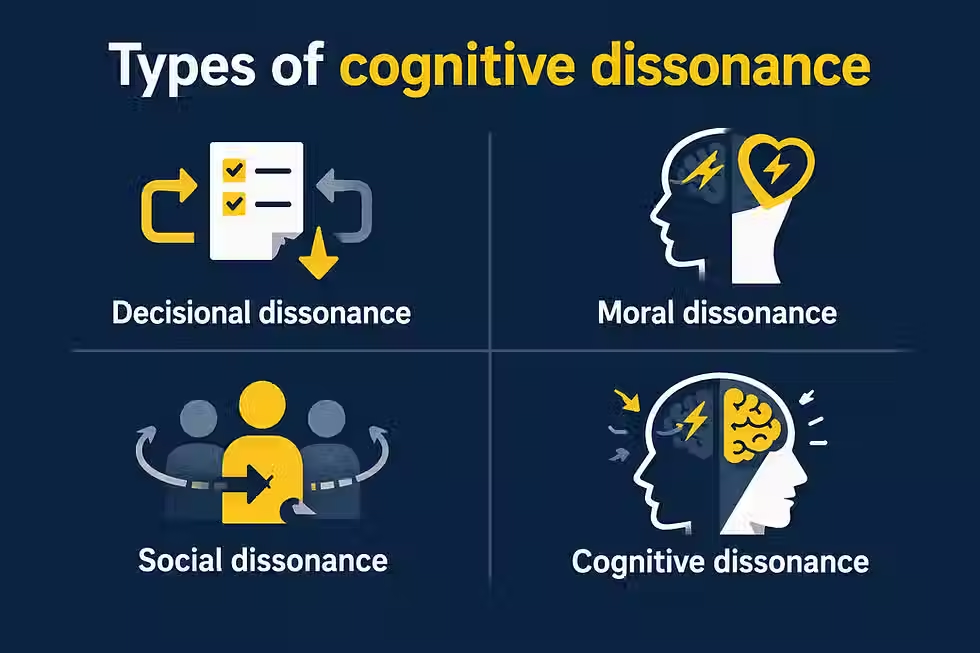
Cognitive dissonance – types.
Psychology distinguishes the following types:
post-decision dissonance - after making a choice,
social dissonance - resulting from group pressure,
moral dissonance - when actions conflict with values,
cognitive dissonance - related to knowledge and facts.
Each of them leads to the same goal: eliminating tension.
Dissonance as a mental state. What exactly do we feel in such a state?
Cognitive dissonance is a state of mental tension. It can manifest itself as:
feeling of guilt,
anxiety,
irritability,
overthinking,
worrying,
difficulty making decisions.
This discomfort makes a person want to reduce it as quickly as possible. Importantly, the point isn't to get to the truth, but to stop feeling the tension.
An example of cognitive dissonance: the cigarette smoker and health.
A classic example of cognitive dissonance concerns smoking cigarettes.
Person smokes (behavior).
Knows about the harmful effects of smoking (knowledge).
These two elements are contradictory. Cognitive dissonance occurs because the knowledge about the harmful effects of smoking conflicts with the fact that he continues to smoke.
To get rid of internal tension, a smoker can:
deny the threat (“my grandfather smoked and lived to be 90”),
downplay the risk (“we’re all going to die from something anyway”),
add a new justification (“smoking calms me down”).
Dissonance is reduced, but at the expense of truth.
How do we try to reduce cognitive dissonance?
There are four main ways to get rid of dissonance:
Changing behavior – e.g. breaking free from an addiction.
Change of mind – e.g. recognition that the risk is lower.
Selective processing of information - e.g. ignoring information about the harmfulness of addiction.
Rationalization – e.g. “smoking helps me cope with stress.”
Each of these strategies reduces tension, but only the first one is actually healthy and consistent with reality.
Why do we so often take shortcuts? The need to reduce cognitive dissonance.
Eliminating cognitive dissonance rarely involves changing behavior, as that requires effort. It's much easier to:
change the interpretation,
deny the facts,
avoid stimuli that cause dissonance.
Therefore, people avoid information that causes dissonance (e.g., they don't read articles that contradict their views). This strategy ultimately leads to cognitive closure.
When does this psychological phenomenon most often occur?
Dissonance most often occurs when our beliefs contradict our behaviors. Psychology shows that it's easier to change our interpretation of facts than to change our actions.
Therefore, cognitive dissonance often leads to:
rationalization,
excuses,
changes in narrative,
reinterpretation of facts.
It's a protective mechanism. It protects our identity and creates the illusion that we are rational and coherent individuals.

Cognitive dissonance and manipulation.
Cognitive dissonance is often used in manipulation, marketing, and politics. Provoking dissonance and then providing a "ready-made solution" is an effective influence technique.
Example:
“You are an honest and responsible person” (identity).
“Honest people support this initiative” (pressure).
The lack of willingness to support triggers dissonance.
To reduce it, a person changes their behavior - often unconsciously.
Manipulation utilizes various persuasion techniques, such as "door in the face," gradual commitment (foot in the door), lowball, or creating the illusion of an opportunity that shouldn't be passed up (script technique). All of these methods exploit the innate need for cognitive coherence.
For example, by making a small request followed by a larger one, a person's decisions can be influenced without direct coercion. People with low self-esteem and uncertainty about their decisions are most vulnerable to this influence.
In a social context, dissonance strongly influences reactions to government or political party actions. Individuals who are staunch supporters of a chosen ideology maintain their views despite compelling evidence to the contrary.
Can coaching help reduce dissonance?
Unlike automatic defense mechanisms, coaching doesn't aim to reduce cognitive dissonance quickly. On the contrary, it helps:
become aware of the existence of dissonance and its source,
name the contradictory elements,
question and reformulate views that do not serve,
trigger new, more supportive behaviors.
Thanks to this, dissonance ceases to be a source of recurring suffering and instead becomes a signal of the need for change. In coaching, it is treated not as a problem, but as a developmental signal. This is the moment when internal inconsistency indicates that the client is on the verge of change.
From a coach's perspective, cognitive dissonance means that:
the customer already knows something,
but he hasn't fully understood it yet,
and internal tension informs us that the current state is not long-term consistent.
Instead of repeating existing unconscious patterns, coaching teaches you how to stop, examine your inner self, and use insights to take the next step in your development.
In coaching practice, internal conflicts very often appear in the following areas:
career and professional work,
leadership and responsibility,
relationships and boundaries,
personal values,
health and lifestyle.
Example:
The client says, "I know this job is burning me out, but I can't change it."
This is a classic state of dissonance. Knowledge of the situation's harmfulness contradicts behavior. This creates tension, which, without coaching, often leads to rationalization ("everyone does it") rather than change.

What coaching questions help you consciously reduce cognitive dissonance?
The following questions are often used in coaching when strong cognitive dissonance occurs:
"In what situations do you most often experience internal inconsistency?"
"Do you see any repeating pattern here?"
“What is contradictory in these situations?”
“What beliefs underlie your current behavior?”
“What do you know but haven’t done yet?”
“What would happen if you stopped automatically lowering the voltage and just let it be?”
"Why don't you change your behavior?"
“What change would be most consistent with your values?”
Questions like these help you move from unconscious tension to conscious choice.
Changing beliefs as a driver of change.
In the coaching process, it often turns out that cognitive dissonance does not originate from the situation itself, but from outdated opinions that the person still treats as true.
Examples of beliefs that maintain dissonance:
“I must be loyal at the expense of myself.”
"Change means failure."
"Safety is more important than sense."
The coach's role is to verify whether the chosen thoughts are still consistent with who the client is today. When a belief becomes irrelevant, the source of dissonance disappears.
From a coaching perspective, cognitive dissonance helps us become aware of our personal shadows and serves a motivational function. It:
triggers reflection,
undermines automatisms,
forces you to ask yourself difficult questions,
expands self-awareness,
initiates the process of identity change.
Without experiencing dissonance, most people would not change anything, even if the situation was objectively unfavorable.
Coaching exercise: "Stop the Dissonance."
This simple exercise allows you to work on your inconsistencies on your own:
Write down a situation in which you feel tension or internal contradiction.
List the cognitive elements that are incompatible with each other.
Ask yourself: “Which of these elements is more relevant today?”
Become aware of what you usually do to avoid dissonance rather than to resolve it.
Consider what real change would restore integrity.
This method helps to move from unconsciously reducing dissonant tension to effectively resolving the conflict that is the source of discomfort and tension.
Individual coaching is an invitation to take responsibility for your own choices. When we suppress or rationalize our internal conflicts, change is impossible. When they are consciously experienced, they become an impulse for action.
📌 Summary: What's worth remembering?
Leon Festinger developed the theory of cognitive dissonance, which became a cornerstone of social psychology.
It is an unpleasant internal state, which is why people often look for excuses to free themselves from it, even at the cost of lying.
Coaching allows us to work with it consciously and remove its source. This increases the individual's authenticity and integrity.
The influence of cognitive dissonance is sometimes used in manipulation techniques and social life.
The greatest personal growth begins where automatic rationalization ends.
Bonus: Cognitive Bias Library for free download.
On our website, you'll find a library of biases that are presented as infographic cards. Each card includes a detailed description and a practical, real-life example. Often, they're accompanied by a touch of humor. These cards are free to download and freely distribute. We encourage you to explore this collection of infographics, which can be found at the following link:
Below we present selected examples of such infographics:

See related articles:
Psychological Phenomena and Cognitive Biases - A Complete Guide.
What are cognitive distortions?
What are the benefits of coaching?
Emotion List and Free PDF Ebook.


Comments