
Cognitive distortions and their impact on decisions

Updated: Aug 31

Cognitive distortions are a key topic in cognitive behavioral therapy because they explain why different people react so differently in similar situations. What we feel and how we behave is not based solely on the facts but on how we interpret them.
In this article, you'll learn what these distortions are, what types they come in, how they reinforce negative thoughts, and how to address them through cognitive and behavioral therapy. This text is a practical guide for those interested in personal development, psychology, and effective therapy.
What are cognitive distortions?
Cognitive distortions are exaggerated, one-sided thinking patterns that distort reality. They are often negative in nature, focusing on threats, mistakes, or failures while ignoring the positive.
These are ingrained, automatic ways of interpreting reality that cause us to perceive a given situation in a biased way. They are not conscious lies to ourselves. This is how our brain functions to simplify and accelerate our assessment of events.
Importantly, distortions occur in everyone. They are not a disorder in themselves, but when they become dominant, they can lead to relationship difficulties, anxiety, or mood disorders, which can develop into depression.
Where do thinking traps come from and why are they so common?
According to psychology, our minds operate on shortcuts. They are unable to process all the stimuli and information consciously. Therefore, they use developed mechanisms that allow them to react quickly, but sometimes the price of this useful mode of response is simplified perception.
Our brain is particularly prone to automatic thoughts in stressful situations. In life-threatening situations, it bypasses the part of the cerebral cortex responsible for rational thinking and immediately switches our body into a "fight" or "flight" state. This response mode plays a very useful role. It protects us from mortal danger and is intended to ensure survival.
Nowadays, we are rarely exposed to such extreme experiences. But we accumulate many other experiences throughout our lives. The periods of childhood and adolescence are particularly important. If we experience trauma or repeated events during this time, it leads to the development of entrenched cognitive patterns.
Here are some examples:
If someone grew up in a home that lacked warmth and "no time" for children, they may enter adulthood feeling worthless. This will result in a lack of self-confidence, an unwillingness to take risks, and a fear of failure.
If someone has experienced repeated criticism in the past, they may perceive so-called "constructive feedback" at work as a personal attack or even rejection.
If someone grew up in an environment where very high expectations were placed on them, and there was no tolerance for mistakes, they will compulsively strive for perfectionism and treat every shortcoming as a personal failure.
In short, this type of rigid thinking involves attributing to ourselves (or others) characteristics that are far from reality. Equally often, we see only the negative aspects of a given situation and quickly focus on the worst possible outcome.

What are the types of cognitive distortions? A basic division.
There are various classifications of cognitive distortions. The most common are divided into 10 or 12 categories. The following list of types reflects their division into 12 categories and provides specific examples of cognitive distortions of each type.
1. Dichotomous thinking - All or nothing.
Dichotomous thinking (also known as black-and-white thinking) involves judging reality in extreme terms: success or failure, exceptional or hopeless, always or never, everyone or no one. There's no room for shades of gray or realistic assessment.
In this pattern, a single failure can cause a person to consider themselves a failure. This is a situation in which a person previously admired becomes a victim of hate because of a single slip-up.
It's also a dangerous way of thinking about oneself that, in the long run, can lead to low self-esteem. It often appears in states of depression and reinforces low self-esteem.
2. Overgeneralization.
Overgeneralization involves drawing sweeping conclusions based on a single experience. One poor presentation at work can make a boss perceive an employee as incompetent. Encountering an aggressive foreigner on the street can make us think critically of all citizens of a given country. One person made a fortune in cryptocurrency, so it's a great business.
3. Exaggeration or minimization.
Exaggeration causes us to focus on negative aspects, mistakes, or threats, while ignoring neutral or positive ones. We distort our perception of reality, overestimate the negative significance of a situation, and react with stress that doesn't correspond to the real threat. As a result, we induce discomfort.
4. Catastrophization.
Catastrophizing occurs when we unthinkingly assume the worst-case scenario in a difficult situation. Even a minor problem escalates into a catastrophe, and the future appears hopeless. For example, "I have pain around my heart. Oh God! I'm about to have a heart attack."
5. Labeling - You are like this, I am like this.
It's assigning general, negative labels to ourselves or others based on individual events. Instead of analyzing a situation objectively, we identify someone (or ourselves) with a mistake, considering it part of identity.
Labeling can hinder personal growth because, instead of considering the causes of a given situation, we immediately jump to the "this is how it is" space. For example, "Paulina made a mistake in the meeting. She's so stupid!"
6. Jumping to conclusions.
It's drawing serious conclusions (usually negative ones) based on vague (or fictitious) premises. For example, "I can't find my studio keys. She must have hidden them somewhere again while cleaning."
7. Mind reading.
Mind reading is the belief that we know what others think of us, and we usually assume it's unfavorable. Instead of simply asking, we draw these conclusions based on individual behavior or even facial expressions. This often leads to misunderstandings and tension in relationships. For example, "He looked at me askance; I knew he didn't like me," or "She's mad at me again. What wrong did I do this time?"
8. Predicting the future.
Fortune-telling is the belief that we know what will happen—usually in a way that will be unfavorable to us. Predictions and catastrophic thinking often occur together and are typical of an anxious thinking style. For example, "I'll definitely fail this exam" or "I definitely won't get this job."
9. Personalization.
Personalization, on the other hand, means taking responsibility for events over which we had no real control. We are convinced that others' behavior is a reaction to our own mistakes.
This unhealthy self-centeredness causes us to perceive reality in a biased and emotionally burdensome way.
10. The imperatives "I must", "I should", "I have to".
Imperative overuse is a specific pattern in which we impose rigid rules on ourselves or others: we should behave in a certain way, others must live up to our expectations, now we need to clean this up.
This compulsive belief leads to frustration, guilt, and tension. Reality rarely meets ideal standards, resulting in disappointment and criticism—of oneself and others.
11. Mental filter (selective attention).
It involves focusing exclusively on the negative aspects of a situation, ignoring the positive elements. It reflects the brain's tendency to reject information that contradicts previously held beliefs. For example, we were once severely criticized by our boss. In each subsequent conversation, we will remember only the negative comments and not register the positive ones.
12. Emotional justification.
It's the assumption that negative emotions reveal the true nature of things. It's the belief that something is true based solely on feelings. For example, "I feel like something bad is going to happen."
Top 50 Cognitive Distortions List.
A well-developed list of cognitive distortions allows us to recognize our own thought patterns. This is the first step on the growth path, as it's difficult to change something we're unaware of. Such a list serves both an educational and diagnostic purpose. Here it is.
A. Interpreting reality in an extreme way.
Dichotomous (black or white) thinking – all or nothing.
Catastrophizing – Assuming the worst-case scenario.
Overestimating negative consequences.
Minimizing the positives.
Exaggerating problems.
Dramatization.
Tunnel thinking – seeing only one dimension.
Selective attention – focusing only on mistakes.
Worst case scenario.
Extreme generalization (“always”, “never”).
B. Errors in prediction and inference.
Predicting the future.
Mind reading.
Jumping to conclusions.
Overgeneralization.
Emotional reasoning (“I feel it, therefore it is true”).
The illusion of control.
Overestimating the likelihood of threats.
Anticipating failure.
Guessing the intentions of others.
Confirmation bias (looking only for evidence for your own thesis).
C. Falsifications regarding the self and self-esteem.
Personalization.
Assigning responsibility for events.
Excessive guilt.
Global self-labeling (“I am hopeless”).
Comparing yourself up or down.
Downplaying one's own successes.
Negative interpretation of one's own intentions
Self-fulfilling prophecy.
Thinking "there's something wrong with me".
Constant internal criticism.
D. Misrepresentations about other people.
Labeling others.
Accusing others of bad intentions.
Excessive suspicion.
Demonizing other people's behavior.
Idealizing or devaluing others.
Generalizing from one person.
Stereotypical thinking.
Attribution error (others are "some", I have reasons).
Personal interpretation of other people's behavior.
Narrowing your perspective to your own point of view.
E. Rigid patterns and pressure.
Overuse of imperatives (“I must”, “I should”).
Rigid moral principles.
Cognitive perfectionism.
The "if it's not perfect, it's pointless" mindset.
Intolerance of uncertainty.
Wishful thinking.
Cognitive avoidance (thought stuffing).
Escape into rationalization.
Oversimplification of reality.
Cognitive rigidity (lack of flexibility in thinking).

Negative thinking, anxiety, and depression treatment.
Destructive thinking plays a key role in the development and maintenance of anxiety disorders and depression. Depression is dominated by negative schemas about oneself, the world, and the future.
Anxiety, on the other hand, involves excessive focus on threats, a lack of confidence in one's own abilities, the anticipation of dangerous scenarios, and a desire to escape. This causes emotions to become more intense than the objective situation would suggest.
How does cognitive behavioral therapy (CBT) work?
Cognitive-Behavioral Therapy (CBT) posits that by changing how we think, we can influence our emotions and behavior. Working with cognitive distortions is a key element of CBT.
The therapist helps the patient:
notice automatic thoughts,
question their truthfulness,
become aware of and name the emotions you feel,
find an alternative, more rational way of viewing reality,
develop new behaviors.
The creator of this approach was Aaron Beck, who described the role of cognitive schemas in depression.

How to work independently with cognitive disorders?
Cognitive therapy, with the support of a specialist, is a good solution when we begin to experience emotional problems. To prevent this condition, everyone can begin working on their own. Here are three key methods that help identify and eliminate errors in our thinking.
Asking yourself questions.
It is worth asking yourself the following questions:
Is what I think an indisputable fact or my opinion?
Am I taking into account all the necessary elements?
What if what I see is only partially true?
What am I not seeing?
How would another person view this situation?
It's also helpful to write down the thoughts that arise in difficult situations and check them for cognitive biases. Such exercises develop cognitive flexibility and reduce the impact of faulty thinking.
The Work of Byron Katie.
Byron Katie is an American author and expert in challenging destructive thoughts. She created a simple and incredibly effective method called " The Work," which we describe in detail in a separate article on the Empowerment Coaching Kraków blog. We highly encourage you to explore this technique and Byron's books.
Self-coaching.
Self-coaching, or coaching yourself, requires a certain level of self-awareness and skill in the art of asking questions. Of the three techniques proposed here, it's arguably the most demanding approach. We recommend it to those with advanced self-development skills.
What is the difference between a distortion and a cognitive error?
That's a very good question! A cognitive bias is a one-time mistake in thinking. A cognitive distortion is a habitual way of viewing the world or thinking about oneself. The infographic below explains the difference in detail.

📌 Summary: Most important things to remember.
Cognitive distortions occur in every person.
These are automatic patterns of interpretation of reality.
They reinforce destructive thinking, anxiety, and depressive symptoms.
Recognizing your own thinking traps is the first step to change.
Asking yourself deep questions, Byron Katie's "The Work" method, and self-coaching can help. And in the case of emotional problems, the best solution will be cognitive-behavioral psychotherapy.
Appendix: Cognitive bias library in graphical form.
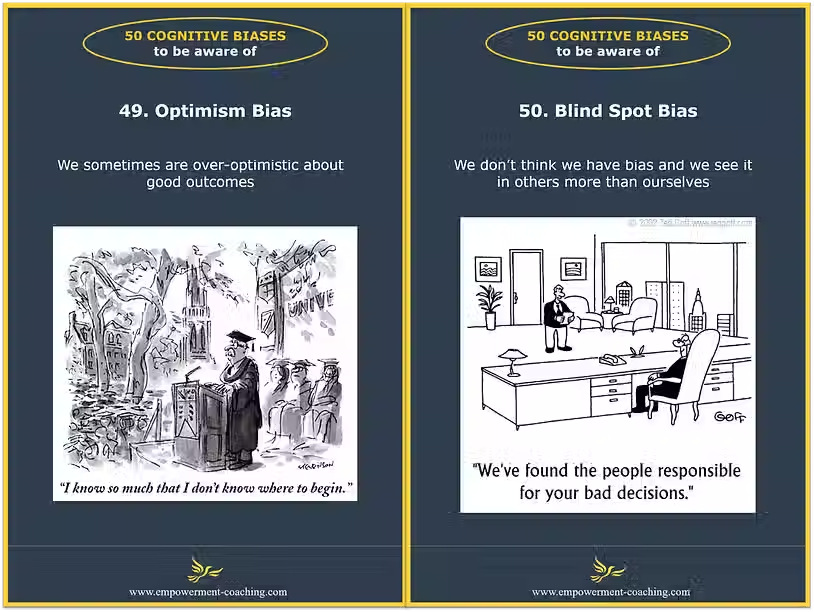
Free training is available on the Empowerment Coaching Kraków portal. This is a library of cognitive biases. We've prepared them as infographics that you can download and distribute freely. Each infographic includes the English name, description, and example of the bias. The examples are often seasoned with humor. The graphics below are examples of such memes.
See related articles:
Psychological phenomena and cognitive biases - a complete guide.
What causes cognitive dissonance?
How does coaching expand self-awareness?
What are the benefits of coaching?
About the author:

Ryszard Skarbek is a certified business coach, mentor, and HR advisor. He has over 30 years of professional experience, including 22 years in an international corporation operating on six continents.
As a coach and mentor, Ryszard works mainly with middle and senior managers and business owners.
His main specializations are 21st-century leadership, interpersonal communication, self-awareness, HR, IT, and Project Management.


Comments